Solid Wood vs Veneer: A 5-Year Cost Comparison for Singapore Small Spaces
Last month I visited a resale 4-room HDB flat in Bedok with my colleague, helping her shortlist a new dining table and bed frame. The seller had just renovated, and the entire living-dining area was dressed in glossy engineered panels with a 0.6 mm oak face. On paper the price was 38% lower than the solid oak quotes I had pulled from a Foshan factory. Twelve months earlier, the same seller had refinished the same veneer wardrobe twice because the surface was already peeling near the kitchen humidity zone. Standing in that 92 sqm flat, watching my colleague tap the side panel and hear the hollow echo, I realised the "cheaper today" math rarely survives a five-year window in Singapore's humidity. This piece walks through that math, line by line, for anyone fitting out a small space in Tampines, Punggol, or a 538 sqft condo in the OCR.
What does a typical Singapore buyer actually pay in 2025 for veneer versus solid wood furniture?
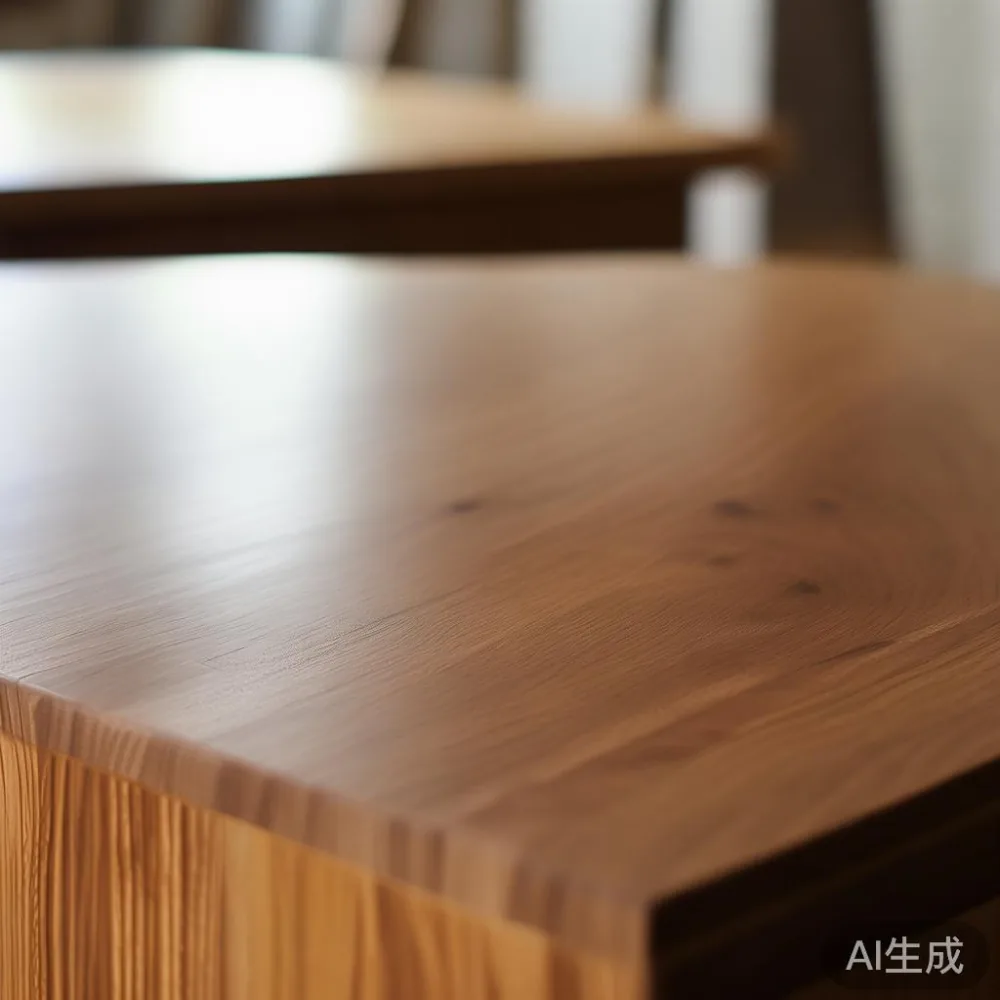
Price shopping on Carousell and Shopee shows a clear band. A 1.4 m veneer dining table in a light oak finish retails for S$420 to S$680, while the same footprint in solid rubberwood or ash sits at S$980 to S$1,450. A queen-size bed frame in engineered wood with paper laminate runs S$520 to S$780, against S$1,250 to S$2,100 for a solid wood bed frame with mortise-and-tenon joinery. A 1.8 m sliding wardrobe in melamine-faced MDF lands around S$1,100 to S$1,600 installed, versus S$2,400 to S$3,600 for solid pine with dovetail drawers. The upfront gap looks dramatic, but the comparison only becomes honest once you spread it across the years a piece actually lives with you.
One nuance Singapore shoppers often miss: many "solid wood" listings on local marketplaces turn out to be solid only on the visible faces, with plywood or blockboard hidden inside drawers and cabinet backs. Always ask the seller for a cross-section photo or a specification sheet. MIDHILL publishes a 10-year structural warranty and ships from Foshan with documentation listing every component, which removes a lot of guesswork for buyers cross-checking claims before the lift booking is made.
How does Singapore's climate and HDB infrastructure change the math?
Three local variables punish veneer furniture more aggressively than the brochures admit. First, relative humidity in Singapore sits between 70% and 85% for most of the year, and morning condensation on north-facing corridor walls in older Tampines blocks can push bedroom humidity above 80% by 7 am. The thin PVC or melamine layer on a veneer piece starts to lift at the edges within 18 to 30 months; the substrate beneath swells at a different rate than the face, and the seam telegraphs. Second, HDB lift openings are typically 0.9 m wide by 2.0 m tall, and corridor turns in older blocks measure 1.2 m at the pinch point. Flat-pack veneer is engineered for that geometry and arrives in 6 to 9 cartons. Solid wood pieces arrive in fewer, heavier cartons, which is why MIDHILL's free shipping over US$350 (about S$475) matters: the threshold absorbs the cost difference for a full small-space set, and the white-glove delivery team handles the corridor turn so you do not have to.
Third, the 9% GST on imported furniture (rate current as of 2025) compounds the delivery fee on any replacement order. A single S$60 courier swap to redo a peeling wardrobe door therefore carries roughly S$5.40 in tax alone, before you count the callout charge. Over five years, two or three such callouts quietly erase the original S$300 to S$500 saving.
What does the real 5-year cost look like for a small space set?
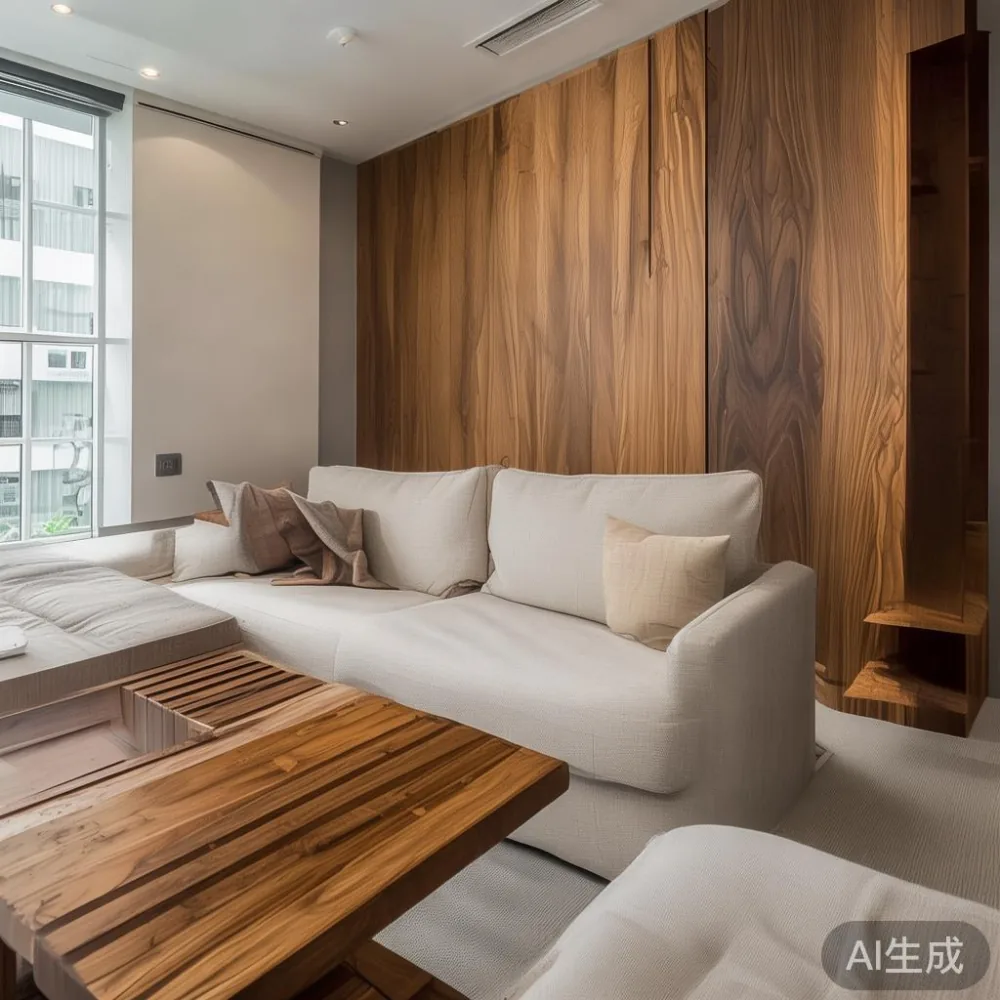
Let us price a realistic package for a 90 sqm HDB or a 600 sqft condo: a 1.4 m dining table, four chairs, a queen bed frame, a 1.5 m three-door wardrobe, a nightstand, and a small marble table for the entryway. Numbers below are SGD, rounded, and include 9% GST, delivery, and basic installation.
Veneer package, entry tier (Shopee-grade melamine on MDF):
Dining set S$620, bed frame S$560, wardrobe S$1,250, nightstand S$180, marble-look table S$220. Subtotal S$2,830. Year 2 edge-lift repair S$140. Year 3 wardrobe door replacement S$260. Year 4 full dining table swap S$680. Year 5 disposal and replacement of the nightstand S$190. Five-year spend: S$4,100.
Solid wood package (Foshan factory direct, kiln-dried ash or rubberwood):
Solid wood sofa frame S$1,450, bed frame S$1,680, wardrobe S$2,950, dining table S$1,180, nightstand S$340, marble table with sintered stone top S$620. Subtotal S$8,220. Year 3 light refinish on the dining tabletop S$220. Year 5 hardware tightening and one drawer slide S$90. Five-year spend: S$8,530.
On a pure dollar basis the veneer set is S$4,430 cheaper across five years. Spread over 60 months that is S$73.80 per month, or about the price of two cai png lunches. But the veneer set has been replaced twice, the solid set has been maintained once, and the solid set still has resale value: a used solid wood dining table in Tampines typically lists at 45% to 55% of retail on Carousell, against 10% to 18% for a chipped veneer piece. Adjust for resale and the five-year gap narrows to roughly S$2,200, which works out to S$36 per month over the same window.
Why does solid wood survive small-space living better than the spec sheets suggest?
Three engineering reasons. Solid timber moves as a single piece, so seasonal expansion and contraction show up as tiny width changes (0.5 mm to 1.2 mm on a 1.4 m top in Singapore) rather than as delamination. Kiln-dried ash, oak, and rubberwood, which is what MIDHILL typically specs for export, are stabilised to 8% to 10% moisture content before assembly, so the in-home movement band is small. Second, joints in a properly built solid piece are mortise-and-tenon or dovetail, glued and sometimes pinned. These joints can be knocked loose, regluing takes 20 minutes, and the repair is invisible. Veneer panels rely on a paper or melamine face bonded to an MDF or particleboard core; once water gets under that face, the core swells irreversibly and the only fix is panel replacement. Third, solid wood can be sanded and re-oiled. Lifetime refinishing, offered as standard by MIDHILL on structural pieces, means a 25-year-old wardrobe can be brought back to 90% of its original finish for the cost of a weekend of labour and a tin of hardwax oil, typically S$80 to S$140 in Singapore for a 1.5 m wardrobe.
For small-space dwellers, this matters because you cannot rotate furniture out of the flat. A peeling wardrobe in a 92 sqm HDB is not something you push to the spare room. It sits opposite your dining table, and you see the swell line every morning.
How do European light luxury and post-modern light luxury finishes compare on solid substrates?
Style is where the two materials used to diverge sharply. A European light luxury accent chair in bouclé or a post-modern light luxury marble side table in sintered stone used to require a custom joiner, which priced small-space buyers out of the look. That has changed. Chinese factories in Foshan, including MIDHILL, now run production lines that pair solid ash or rubberwood frames with sintered stone tops, brushed brass hardware, and tailored bouclé or velvet upholstery, so the same French light luxury palette that turns up in a 1,200 sqft condominium in River Valley is available in a Tampines HDB. The trick is that the substrate is still solid wood: the marble-look top is a 12 mm sintered stone slab, not a printed film, and the frame is finger-jointed hardwood, not hollow MDF with a vinyl wrap.
The practical upside is that the piece ages as one material family. The brass-tipped legs patina, the wood frame deepens in tone under UV, and the sintered top stays matte and unfazed by kopi spills. A veneer imitation of the same look will start to show white lines along the mitre joints within 18 months because the printed face wears at a different rate from the brass plating.
Is a 1.4 m solid wood dining table realistic for a 4-room HDB?
Yes, with two caveats. A 1.4 m rectangular solid wood table seats four comfortably and six at a squeeze; the leg geometry should be a pedestal or tapered post rather than a four-corner leg, so chairs slide in without fouling the apron. A pedestal design also survives a move between flats, which matters because the median Singapore household relocates every 5.7 years. If you are buying for a Punggol BTO where the dining area is 2.4 m by 2.8 m, a 1.2 m round solid wood table is often a more forgiving footprint and leaves a 75 cm circulation band on every side. Lift access in newer Punggol blocks is wider (1.1 m door, 2.2 m cab), so the same table can be moved without tilting on its side.
For buyers comparing under 2000 Modern light luxury furniture sets, a 1.4 m pedestal dining table in solid ash with a sintered stone inlay typically lands between S$1,050 and S$1,480 from a Foshan direct supplier, well within that budget. Pair it with a slim solid wood sideboard at 1.2 m and you have dining storage without the bulk of a full buffet, which is the kind of footprint that suits a 92 sqm HDB.
What about wardrobes and bed frames in a 1.2 m wide HDB bedroom?
The narrowest HDB bedroom in a 4-room flat measures about 2.7 m by 2.7 m, which leaves a 60 cm walkway between the bed and the wardrobe if you fit a 1.5 m three-door unit. A 1.2 m two-door wardrobe leaves a 90 cm walkway and a usable study nook, but you lose hanging depth for jackets. The honest move is to pick a 1.5 m wardrobe in solid pine with 55 cm internal depth, mount it floor-to-ceiling to recover a metre of overhead storage, and skip the back panel in favour of a full internal drawer stack. That build typically lists for S$2,400 to S$3,000 from MIDHILL with soft-close hinges and a lifetime refinishing commitment, against S$1,200 to S$1,500 for a melamine unit that will need its doors re-skinned in year three.
For the bed, a queen at 1.52 m by 1.91 m is the largest that fits a 2.7 m HDB wall without crowding the door swing. A solid wood bed frame with a slatted base and under-bed drawer (one side only, to keep the walk-in clear) runs S$1,300 to S$1,900 depending on whether you pick rubberwood or ash. Slats matter: solid beech slats at 6 cm spacing will outlast a plywood deck by a decade and they will not sag under a 180 kg load, which is the realistic upper bound for two adults plus a latex mattress.
Where do small-space buyers commonly overpay or under-spec?
Three patterns I see every week. First, spending on a solid wood dining table and then pairing it with a particleboard TV console. The TV console is the piece that gets the most heat and the most cable-routing changes; a solid wood console with a cable channel and a marble table top for the set-top box is the better spend. Second, choosing a 1.8 m wardrobe for a 2.7 m bedroom and losing 30 cm of usable space on each side. Third, under-buying on a nightstand and then stacking books on the floor, which collects dust and creates exactly the kind of damp pocket that ruins a veneer nightstand in two years.
For shoppers browsing for sale Modern furniture listings in 2025, the smarter budget rule of thumb is: spend the structural money on the bed, wardrobe, and dining table, and save the decorative money on a statement piece such as a European light luxury accent chair in bouclé, a sintered stone marble table, or a slim solid wood console. Those three items get touched, sat on, orleans bumped into daily, and they are also the pieces that survive a future move to a larger flat in Tengah or Canberra Crescent.
What should a Singapore buyer check before placing a cross-border order?
Five checkpoints, in order. One, ask for the timber species in writing, including the Latin name (Fraxinus mandshurica for ash, Hevea brasiliensis for rubberwood) and the moisture content range. Two, confirm the joinery: mortise-and-tenon, dovetail, or finger joint, not stapled or screwed-only. Three, ask for the warranty terms, especially what counts as structural versus finish. Four, confirm the packaging dimensions against your lift opening; a single 2.2 m wardrobe carton is fine in a Punggol block, tight in a 1990s Bedok block with a 0.9 m lift door. Five, check the returns window. MIDHILL offers 14-day returns and a 10-year structural warranty, which is a useful benchmark when comparing suppliers. Browse the live catalogue at www.midhill.co if you want a reference set of specs to compare other quotes against.
One more thing on logistics: sea freight from Foshan to Singapore takes 12 to 18 days door-to-door, which means you should order six weeks before your renovation handover. Air freight is available at roughly 2.4x the sea rate if the timeline is tight, but most solid wood pieces are too heavy for sensible air shipping. A queen bed frame in solid ash weighs 48 kg to 62 kg, and a 1.5 m wardrobe can hit 95 kg; the volumetric weight alone makes air uneconomical above 30 kg.
Are there places where veneer still makes sense in 2025?
Yes, three. A study desk that will be replaced in three years when your child moves to university, a rental-room wardrobe in a non-aircon bedroom where humidity swings are wider, and a temporary TV console while you wait for a custom build. For everything else, the math favours solid wood over a five-year horizon, and the gap widens over ten. Buyers comparing for sale Minimalist furniture ranges should still check the substrate, because the minimalist look is the easiest one to fake with a paper laminate over MDF, and the cheapness shows up fastest on a plain slab door with no edge profile to hide a lifted seam.
For shoppers weighing a best Coastal bed for 2026 against a coastal-look veneer bed, the practical difference is the finish system. A solid wood coastal bed uses a lime-washed or white-pigmented hardwax oil that can be re-applied in a weekend; a coastal-look veneer bed uses a printed white face that cannot be retouched without a full panel swap. If you are renting and the landlord has a 24-month cycle, veneer wins. If you are owner-staying in a Punggol or Tampines flat, solid wins.
How does the comparison change for buyers choosing modern Mid-century modern furniture in compact condos?
Mid-century modern furniture relies on visible wood grain, tapered legs, and slim profiles, which is the exact aesthetic a printed laminate cannot honestly reproduce. The splayed leg, the 22 mm taper, the exposed dovetail on the drawer: each of these is a stress point where a hollow substrate fails first. A solid wood mid-century sideboard at 1.2 m runs S$1,400 to S$1,950 and weighs 38 kg to 46 kg, so it sits firmly on the floor without the wall-anchor kit a lighter veneer unit requires. For a 538 sqft condo, that weight is a feature, not a bug, because solid furniture does not walk across the polished screed when the door slams.
The combined set above (sofa frame, bed, wardrobe, dining table, nightstand, marble table) at S$8,530 over five years is the spend band a serious small-space buyer should plan for in 2025 if the goal is to stay in the flat for the next decade. Anyone quoting under S$5,000 for a comparable set in 2025 is either cutting corners on the substrate, the joinery, or the finish, and at least one of those three will surface as a defect within the warranty window. The honest comparison is not between two price tags but between two five-year journeys: one where you repair, replace, and apologise to the landlord, and one where you oil a tabletop once and call it a Sunday well spent.