Solid Wood Furniture Prices: What You Really Pay For
A solid oak dining table can cost SGD 1,200 at one showroom and SGD 4,800 at another, yet both descriptions may sound convincing. The price gap usually has little to do with the word solid wood. It comes from timber species, grade, thickness, construction, hardware, finish, size, and the work required to make the piece fit a particular home.

That distinction matters in Singapore. A sofa arriving through an HDB lift, a bed turning inside a Bedok condo corridor, or a wardrobe being carried up four flights can cost more to deliver even before anyone decides whether it deserves a higher selling price. Budget shoppers often compare photographs, while informed buyers compare measurable specifications.
MIDHILL makes solid wood furniture in Foshan and has supplied 15-plus countries since 2008. Its 10-year structural warranty and lifetime refinishing service reflect a long-term approach to material and construction, but they do not make every design equally expensive. Here is a practical account of what moves the number.
Is timber species the biggest price driver?
Yes, species is usually the first major variable. White oak, American walnut, cherry, ash, teak, and rubberwood can all be sold as solid wood, but they have different supply patterns, working properties, yields, and market demand. European oak may carry a higher cost than common Asian hardwoods because of origin, processing, and scarcity. American black walnut is often priced for its figure and dark colour rather than merely its use as timber.
“Solid” describes construction, not prestige. A drawer made only from solid wood may use inexpensive boards with solid timber faces. A bed frame may combine solid structural rails with plywood or engineered panels in hidden areas. Neither is automatically poor, but the terms should not imply that the whole product has identical material throughout.

Check the exposed faces, frame, legs, rails, drawer sides, and back panels. Ask for the scientific or commercial species name, grade, and moisture content. For furniture used in humid Singapore conditions, around 8–12% moisture content is a useful discussion point, although finished pieces should also be acclimatised indoors rather than judged from a factory reading.
Thickness changes the equation too. A 25 mm tabletop consumes more usable timber than an 18 mm top, and defects must be placed around edges, joints, and undersides. Ten solid boards may cost more than four boards because of yield loss. Fancy matching, bookmatching, or continuous grain patterns can reduce usable area further. Those choices may be beautiful, but customers pay for selected material, not only its final visible area.
Why do joinery and hidden construction affect price?
Joinery determines how a dining table, bed frame, wardrobe, or nightstand handles repeated loads. Mortise-and-tenon joints, dowels, screws, steel brackets, and concealed fasteners each have different labour and material requirements. Machine cutting is fast; hand fitting, repeated checks, and controlled assembly take more time.
Last month I visited a workshop where a craftsman prepared mortises for a bed frame. The components looked simple, yet he checked each joint against the mating rail before trimming it by fractions of a millimetre. That precision prevents a rail from rocking or pulling away under load. The process illustrates why a simple silhouette can still command a serious price: the shape is not the whole product.
Load paths deserve attention. A dining table should be judged by its top, apron, legs, and bracing rather than by appearance alone. For a typical household, a 180 cm table seating 6 people may carry repeated loads of 80–150 kg. A bed frame must support the mattress and occupants, often around 180–250 kg across the sleeping area, while resisting side loads when someone sits on its edge.
Back panels affect use as well as cost. A wardrobe with a full 18 mm back is heavier and more resistant to racking than a 6 mm panel fitted into a rebate. A 9 mm back can still work when installation is planned properly, but it may be lighter. For solid wood sofas, the timber frame may include engineered reinforcement at high-stress points. That combination can be rational; it should simply be disclosed.
Hardware is another measurable factor. Standard hinges and slides may keep a wardrobe near SGD 900, while soft-close systems, precise runners, thicker rails, and branded locks can add SGD 120–600. Drawer extension systems alone may add SGD 40–180 per drawer. Cabinet hardware is not decoration: a poorly aligned runner can make a narrow HDB bedroom feel frustrating even when the carcass looks refined.
Does size and weight explain why one piece costs twice as much?
Partly. More timber, more labour, more hardware, and more freight all cost money, but low-density hardwood can complicate the relationship between volume and weight. A large wardrobe using 18–25 mm boards may weigh 90–160 kg. A solid wood sofa may weigh 70–120 kg depending on frame size and upholstery, while a king-size bed frame can reach 70–110 kg.
Small-space planning adds constraints that catalogues rarely show. In Tampines, a corridor may be about 100–120 cm wide with a 90 cm turning zone near the lift. In Punggol or Bedok condos, access routes can include 85 cm wide glass doors, 1.8 m ceilings, narrow lobbies, and a right-angle turn. A wardrobe 60 cm deep is useful against a wall, yet a 55 cm depth may open up more circulation. A 160 cm dining table can seat 4, while a 140–150 cm version may fit a compact kitchen-dining zone better.
Compare usable internal dimensions, not only external size. A 90 cm bedside drawer with 44 cm usable width can hold more than a 100 cm model with large internal partitions. A wardrobe with sliding doors may save 80 cm of clearance, while a hinged 60 cm leaf needs more space to open. A lift measuring 100 cm wide and 110 cm deep may reject packaging that the assembled item could fit. Ask for packaged length, width, height, and gross weight, not just assembled measurements.
MIDHILL offers free shipping above US$350, which is shown in US dollars because the offer follows international commerce terms; Singapore purchases should still be checked for the quoted local delivery price and GST treatment. Delivery may take 7–14 days after production or dispatch, while made-to-order work commonly needs another 4–8 weeks. A model available in 7 days may therefore cost less than one built to specification over 45 days.
Which finish options add cost without adding value?
Finish is where quoted prices often become difficult to compare. One seller may price an oiled table with water-based matt lacquer, another a polyurethane finish, and a third a factory-applied stain followed by 3 protective coats. These processes have different materials, labour, repair methods, and appearance under changing humidity.
Water-based matt finishes often suit clean contemporary interiors and tend to be thinner, while oil-wax treatments make wood grain tactile but may need care around heat and moisture. Lacquer may be more familiar to some buyers but can be harder to renew locally if the original colour system is unknown. Matching a repair is not simply a matter of applying a darker stain. UV exposure, wood porosity, and previous coats all affect the result.
Samples can prevent expensive disappointment. Ask for a board at least 10 cm by 10 cm, preferably cut from the same finish batch. Test it on an inconspicuous side or underside for 24–72 hours. For a dining table in a bright HDB living room, note how the surface behaves near a window receiving 2–4 hours of indirect daylight. A nightstand is less exposed, but its top should still avoid rings from a glass at 18–22°C.
Colour itself does not necessarily indicate quality. Walnut stain on cheaper timber can look convincing at first glance, while pale oak with restrained figure can signal careful selection. The useful questions are which species was used, how deeply the colour penetrates, how many coats are specified, and whether a future refinishing service is available. MIDHILL’s lifetime refinishing policy gives some buyers confidence that wear can be treated, although transport, scope, and exclusions should be confirmed in writing.
What makes a solid wood sofa or bed frame worth its price?
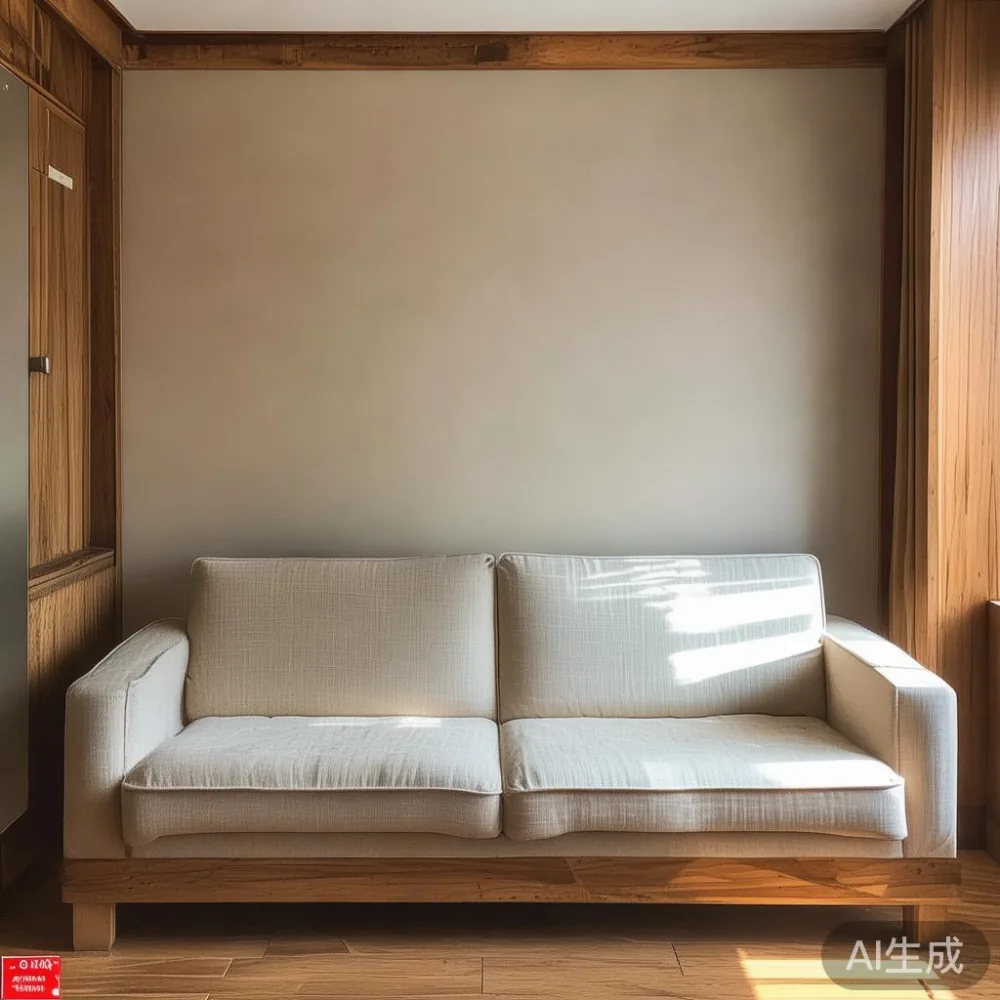
A solid wood sofa combines several separately priced systems: the frame, joints, suspension, foam, fibre, cover, stitching, and labour. The visible wood may draw attention, but comfort is engineered below it. Foam density, layer thickness, and spring or webbing arrangements can create a larger price difference than the timber species. A 220–240 cm sofa may cost SGD 1,800–5,500 depending on those inputs and upholstery.
For a European light luxury sofa, buyers may pay for form, material coordination, and upholstery detail rather than rare timber alone. Tufting, hand-finished seams, shaped arms, and carefully matched fabric can add hundreds of dollars. The phrase “light luxury” describes restraint and finish, not a fixed construction standard. Compare the frame connection points, removable cover availability, seat depth of 55–60 cm, and actual foam specifications.
For a bedroom, searching Japanese bed vs Japandi bed may create confusion because the two labels can overlap. Japanese-inspired low platforms often use simple lines, calm proportions, and visible joinery; Japandi commonly combines Japanese restraint with Scandinavian warmth. The material list matters more than the style label. A queen bed frame should be around 160 cm by 200–210 cm for common mattresses, but storage may add 20–40 cm of length and restrict corridor access.
A marble table makes a useful contrast. Carrara and Calacatta marble slabs may vary in veining, thickness, reinforcement, and fabrication. A 110 cm marble table may cost more than a solid wood table of similar length because slab selection, polishing, transport, and breakage risk are material factors. Price by the actual slab, not only by “marble table”.
How should I compare a dining table, wardrobe, and nightstand fairly?
Request the same level of detail from every seller. For a dining table, record top thickness, species, grade, length, edge profile, leg section, apron dimensions, joint type, finish, and assembled weight. For a wardrobe, record carcass thickness, back thickness, drawer or sliding-door hardware, internal width, hanging space, and installation allowance. For a nightstand, verify drawer dovetails or mechanical joints, internal dimensions, wall clearance, and finish.
Build a simple like-for-like total. A 180 cm oak dining table might be quoted at SGD 1,450 in one specification and SGD 2,300 in another. If the second has a 30 mm top, hardwood legs, stronger apron joints, continuous-grain matching, and a 5-coat matt finish, the difference may be defensible. If both offer 20 mm solid tops with comparable construction, one price appears unusually high.
Wardrobes also carry installation effects. A 120 cm wide, 60 cm deep, 220 cm tall model may require 10–20 cm above for hinge movement and levelling, depending on the system. Sliding doors reduce that demand but occupy more frontal width than hinged doors. Verify whether old furniture removal, carrying upstairs, and on-site anchoring are included. HDB and condo management rules may affect drilling or corridor reservations.
Style can influence labour without making the product structurally different. Modern light luxury for apartment projects often use pale oak, warm neutrals, slim profiles, and minimal hardware. French light luxury styling may introduce curved edges, upholstered details, brass-coloured accents, or decorative fronts. Post-modern light luxury may combine traditional proportions with simpler forms. Those references can guide a design brief, but they should not replace material facts.
The European light luxury sideboard is another example. At 160–180 cm long, its price may rise because it contains aligned doors, veneer or solid wood panels, precise reveals, drawers, marble sections, and integrated cable management. A European light luxury sofa and a Modern light luxury sideboard can share a restrained visual language while costing differently because their functional assemblies are different.
What delivery and service details belong in the real total?
Start with the final invoice, including Singapore GST where applicable. Compare the quoted SGD product price, delivery charge, installation, insurance, and payment timing. A 6% GST calculation on a taxable SGD 2,000 item adds SGD 120. Installation at SGD 80–180 is not equivalent to curbside delivery at SGD 40.
Check return and warranty terms against actual numbers. MIDHILL provides a 14-day return policy, a 10-year structural warranty, and lifetime refinishing, but buyers should confirm the conditions applying to custom dimensions, upholstery, delivery damage, and restored finishes. A refund may require the item to be unused, intact, and returned in its original packaging; the exact procedure should be known before ordering.
Ask for the model revision. Furniture is measured by factories, not by mathematical perfection. A 180 cm dining table may vary by 2–5 mm, drawer gaps by about 2–3 mm, and wood tone by batch. Allowing 30–60 days for receiving and acclimatising a custom piece can prevent a rushed decision. White goods still contain VOC emissions for some time, and freshly delivered wood should be ventilated for roughly 7–14 days before close clothing or books are placed against it.
The most useful price rule is simple: pay for the component you can verify. Timber species, thickness, grade, joint, hardware, finish, dimensions, weight, packaging, delivery, and warranty are evidence. A large logo, an undefined claim such as “premium hardwood”, or a fashionable label is not evidence.
For a MIDHILL TV console, for instance, a 150 cm unit may need a reinforced top, adjustable shelves, concealed cable routes, ventilated bays, and a wall-securement design. If one console uses 18 mm solid wood sides and the other uses veneer-faced panels, compare the internal structure and mounting points. A console can sit in a compact living room without becoming a bulky storage block, and the right width may be 120–160 cm depending on the sofa and lift route.
A good solid wood price is not simply low or high. It is proportionate to the material and work. A SGD 980 nightstand with sound joints and accurate drawers can make more sense than a SGD 1,650 model with vague claims. A SGD 1,400 wardrobe with usable internals may suit a small space better than a SGD 2,500 oversized box. Measure first, request written specifications, then compare complete products rather than isolated words.